
Anyone who has spent time in the land surveying profession knows this to be true: no two parcels tell exactly the same story. Title documents say one thing, physical monuments say another, and the neighbor's fence sits somewhere in between. Survey discrepancies and boundary disputes are not rare edge cases — they are a regular part of the work, and understanding what causes them is the first step toward resolving them properly.
Why Survey Discrepancies Happen in the First Place
Land records are historical documents. A legal description written in 1952 used the technology, language conventions, and reference points available at the time. When a licensed surveyor revisits that description today with modern GPS equipment and a fresh set of eyes, differences will surface. That is not evidence of wrongdoing — it is evidence that surveying is a cumulative science built on a long chain of human decisions and physical markers that change over time.
The most common sources of survey error fall into a few recurring categories.
Measurement and Equipment Error — Even with today's total stations and GNSS receivers, field measurements carry tolerances. Older surveys done with chain and compass equipment carried larger ones. When a parcel has changed hands a dozen times and each conveyance relied on a prior description, small measurement variations compound into noticeable discrepancies at the ground level.
Ambiguous or Conflicting Legal Descriptions — A metes-and-bounds description that calls for "the old oak tree at the corner of the Smith property" creates an immediate problem when the tree is gone, the Smith property has been subdivided, or competing interpretations place the starting point in different locations. Deed language that made perfect sense at the time of writing can become genuinely ambiguous a generation later.
Lost, Moved, or Disturbed Monuments — Survey monuments — iron pins, concrete posts, brass caps — are the physical anchors of a property boundary. They get disturbed by construction, buried over time, removed during road work, or simply corroded beyond recognition. When a monument called for in a deed cannot be found in the field, the surveyor must reconstruct the boundary using other evidence, and that process can lead to different conclusions depending on the methodology applied.
Overlapping Deed Descriptions — In areas settled before standardized cadastral systems were in place, adjacent parcels were often described independently without rigorous coordination. The result is occasional overlap — two legal descriptions that each include the same strip of ground — or gap — a strip of land that neither description technically covers. Both scenarios create legitimate title and boundary questions that require careful professional analysis.
Errors in Prior Surveys — It happens. A previous surveyor made a calculation mistake, placed a monument in the wrong location, or misread a deed. When a later survey corrects the record, the discrepancy between what the old survey shows and what the new survey shows can surprise property owners who assumed their boundary was settled long ago.
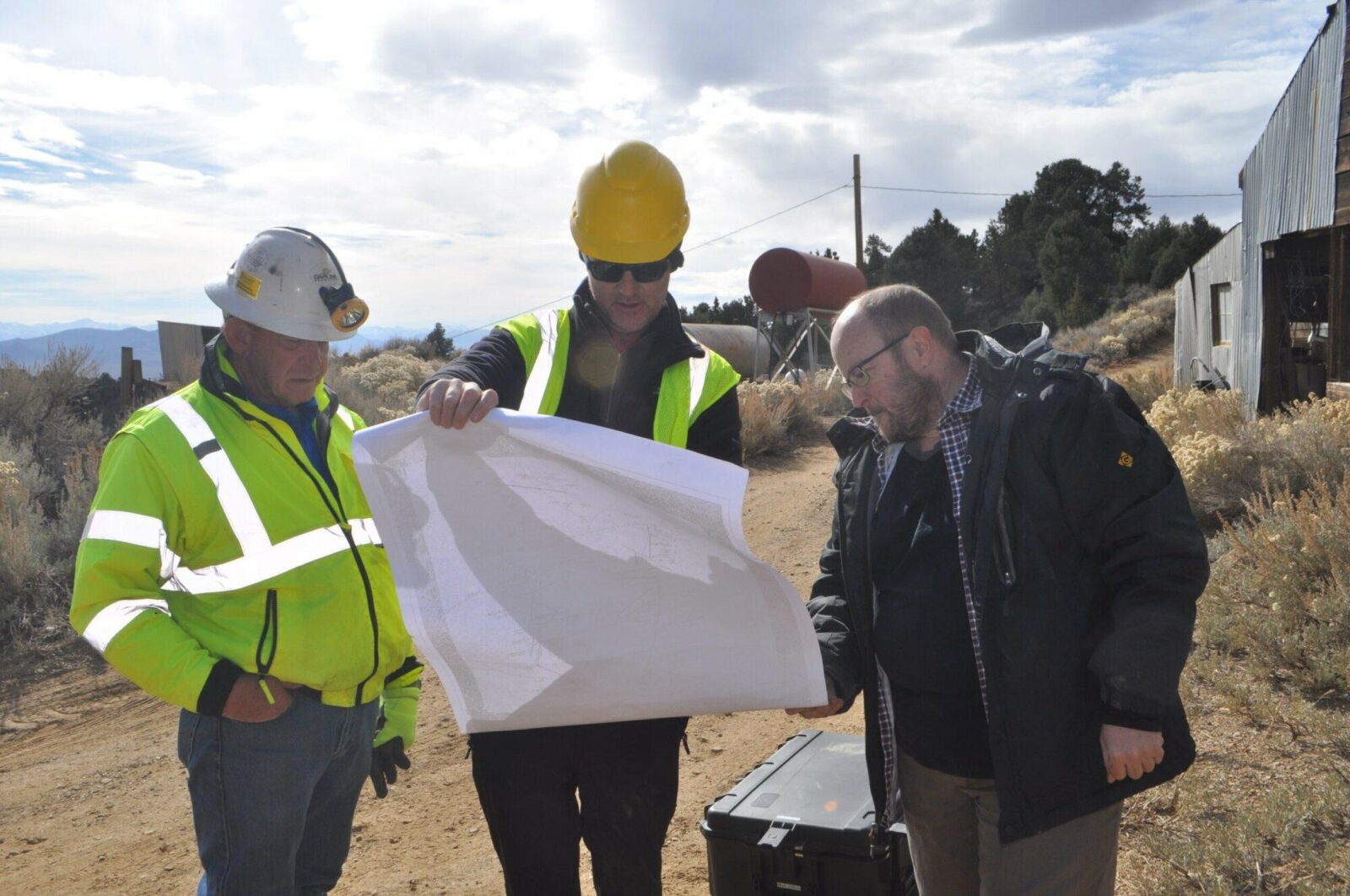
Mines worldwide rely on our decades of expertise in mine surveying and mapping.
How Professional Surveyors Approach Resolution
Resolving a survey discrepancy is not simply a matter of re-measuring. The process is as much legal and historical as it is technical, and experienced surveyors approach it as a research problem before it becomes a field problem.
The first step is a thorough title and record search. Surveyors examine the chain of title for the subject parcel and all adjoining parcels, looking at deeds, subdivision plats, court records, easement documents, and any prior surveys on file. Understanding the full history of how a parcel was created and conveyed is essential context before any field work begins.
Next comes the evidence hierarchy. Surveying law — codified differently in each state but consistent in its general principles — establishes a priority order for the types of evidence a surveyor uses to establish a boundary. Original monuments, when they can be found and authenticated, carry the most weight. Called-for distances and bearings yield to found physical evidence. Surveyors working through a discrepancy apply this hierarchy to determine which evidence is most reliable and how conflicting evidence should be weighted.
Field reconnaissance then tests the documentary research against physical reality. Where are monuments actually located? What does the occupation on the ground — fences, structures, driveways, landscaping — suggest about how the boundary has been treated historically? In cases where long-standing occupation differs from the deed description, the doctrine of acquiescence and related legal concepts may be relevant, and the surveyor's analysis should acknowledge that dimension even if a legal resolution ultimately falls to a court or title attorney.
When the evidence supports a clear conclusion, the surveyor prepares a survey plan, a legal description, and a report that documents the methodology, the evidence relied upon, and the basis for the boundary determination. That record becomes part of the property's history and provides a defensible basis for resolving disputes with neighbors, title companies, or municipalities.
When a Boundary Dispute Involves Neighbors
Not every discrepancy becomes adversarial. Many boundary questions are resolved through a boundary line agreement — a formal document signed by adjacent property owners that establishes the boundary location by mutual consent and is recorded with the land registry. This is often a faster, less expensive, and less damaging outcome than litigation, and a professional survey is the foundation that makes a fair agreement possible.
In more contentious situations, courts rely heavily on survey evidence. A well-documented survey from a licensed professional land surveyor, prepared in accordance with applicable standards of practice, carries significant evidentiary weight. The quality of the underlying research and the clarity of the surveyor's report can be decisive.
The Broader Picture
Survey discrepancies are a natural feature of a land tenure system built incrementally over centuries. They do not always mean someone made a mistake, and they do not always require a legal fight to resolve. What they do require is careful, methodical work by a surveyor who understands both the technical and legal dimensions of boundary determination.
At Darling Ltd., our team approaches every boundary question with that combination of skills — field precision, documentary research, and professional judgment built through years of working through exactly the kinds of discrepancies this article describes. If you are dealing with a survey question on a current project or property transaction, contact our team to discuss how we can help.
Sign up for our email newsletter to receive updates on the latest in engineering technology that will help improve your projects' efficiency, safety, and costs.